Sinclair Media Operations Fabric: Designed for Transformation
Sinclair began this work with a strategic requirement: neither technology nor the operational complexity it supports could continue to constrain business opportunities or slow our adaptation to changing audience behavior. Mike Kralec, EVP and Chief Technology Officer, framed the task as ensuring technology was an enabler of rapid business decisions and value creation rather than a roadblock. That required more than replacing individual systems or solving singular problems. We undertook an intentional, multi-year transformation of the technical operating model for local content, designing media management, automation, playout and news as connected workstreams, enabled with data and organized into one expanding media fabric.
As of August 7, 2026, the Amagi and CCT News deployments collectively reached 69 Designated Market Areas (DMAs), representing approximately 34.7% of the 2025–26 U.S. television and broadband household universe. At the approved end state, that reach will expand to 83 DMAs and approximately 38.2% of that household universe.
The fabric that enables our transformation comprises three common elements: cloud compute and storage; shared media and metadata conventions; and normalized operational messages exchanged through the Sinclair Media Bus. The corporate network, structured Amazon Web Services accounts, common naming and tagging, and enterprise security, auditing and support practices reinforce that foundation.
Within this architecture, media remains accessible in shared storage; its meaning travels with it in durable metadata; and its operational state is available to any authorized service. As a result, no application needs to maintain a separate copy of the media, reinterpret its metadata or build a proprietary connection to every other component.
Each workstream uses that foundation and then adds to it. It consumes shared repositories, metadata, events and services contributed by preceding workstreams, then returns reusable capabilities through normalized Media Bus messages, shared services and integration patterns. “Open” in this context describes capabilities with which other Sinclair services can interoperate; it does not require every component to be open-source software. This consume-and-contribute model allowed the program to advance in stages without losing its long-term architectural direction.
As Kralec said, “This is not one transformation. These technologies are the foundational element of continuous transformation throughout the organization.”
The impact on the business and its audiences is substantial. Production deployments, operating volumes and the retirement of legacy infrastructure demonstrate that impact. The design anticipates continued change, yet it is practical and proven in daily operation while the approved rollout
continues.
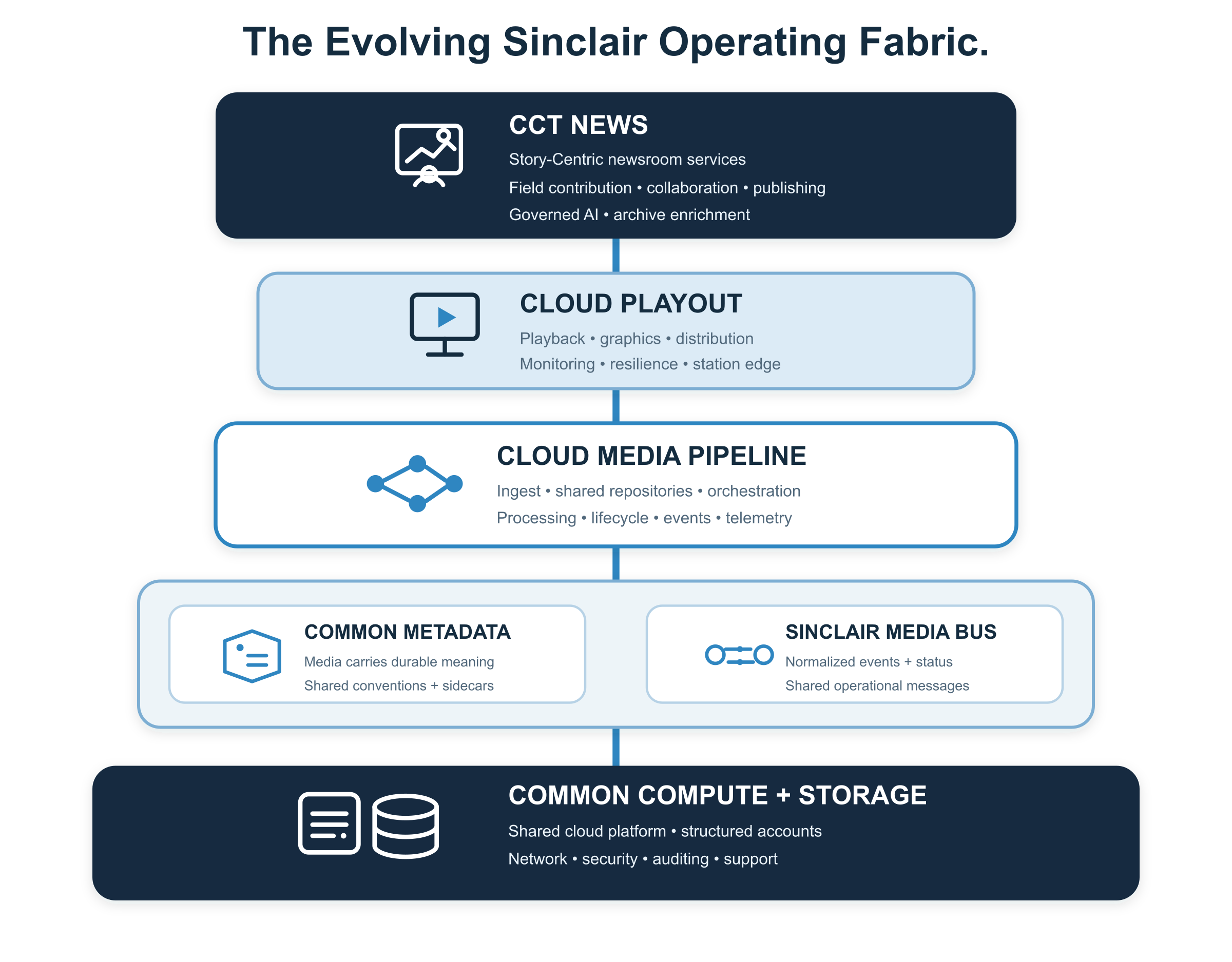 Figure 1. Each SInclair workstream consumes common compute and storage, media and metadata, and Media Bus messages, then contributes reuseable services that evolve the fabric for the workstreams that follow.
The Cloud Media Pipeline (CMP) was the first transformation to use and extend the fabric nucleus. CMP centralized the media supply chain from 65 individual receiving and processing locations to a single point of ingest and a common source of truth for metadata. CMP made media, Broadcast eXchange Format (BXF) metadata sidecars, deterministic orchestration, elastic processing, lifecycle management, operational events, integration patterns and telemetry available as shared services. It now processes approximately 14,000 unique files each week. This allows downstream services to connect to prepared media, durable metadata and an observable workflow already in production.
Amagi cloud playout was the next downstream workstream to join the fabric. It consumed CMP-prepared commercials, syndicated programs and promos, along with their metadata and operational events, and added resilient cloud playout, graphics, direct distribution, shared monitoring,
standardized station-edge patterns and location-independent control as both technical products and
consumable services.
Content Center Transformation—News (CCT News) joined the fabric as the third workstream and consumed services from both preceding layers: CMP for media and workflow services, and Amagi for playout, graphics and distribution. Reporter-Driven News (RDN) demonstrates the cumulative result. A finished package can move from the field through Signiant contribution and CMP processing into the Amagi playlist within the Fonn-supported editorial workflow. News, media management and playout operate as connected services instead of requiring another set of station-specific handoffs. CCT News adds field contribution, story-centered collaboration, archive enrichment, governed artificial intelligence and human-approved multiplatform publishing back to the fabric.
The architecture was designed to continue evolving after these first three workstream deployments. In July 2026, Sinclair replaced a core CMP workflow component with a Sinclair-managed serverless service while preserving the boundaries used by adjacent systems. By August 2026, four vibe-coded projects had entered production. Each reused established fabric capabilities and controls before contributing another focused service. These developments demonstrate the program's long-term intent and its governed capacity for continued adaptation. The sections that follow establish that case in detail. They examine how the evolving fabric solved specific business needs while enabling solutions to each subsequent workstream's operating problem. They also address production impact and scale, resilience and governance, and the ability of future workstreams to consume fabric capabilities and contribute new ones.
Fabric Core
The Sinclair Media Operations Fabric provides core services and a foundation for continued growth
The fabric core provides services fundamental to current and future workstreams, which in turn contribute capabilities back to the fabric. These services include the enterprise network, Amazon Web Services (AWS) compute, corporate security and administration, carefully structured accounts, common resource naming and tagging, and standards governing data and media lifecycles and their organization in Amazon Simple Storage Service (Amazon S3).
The foundational services also include the Sinclair Media Bus, enabled by Amazon Simple Notification Service (Amazon SNS), through which workstreams communicate within the fabric. These messages are retained in a data lake, with management, analysis and reporting provided by Snowflake. Other enterprise and AWS-native reporting tools provide granular security and performance monitoring.
These core elements provide both a foundation for workstreams and the ability to monitor, measure and track the performance of fabric components throughout operation and continued evolution.
Careful planning and construction of these core elements, combined with the ability to measure and track the effects of changes within the fabric, enabled the rapid development and deployment central to the program's success.
Cloud Media Pipeline Supply Chain
From 65 individual on-prem station workflows to one shared device
The Cloud Media Pipeline (CMP) was built on the fabric core and became its first extension when it entered limited production as a live prototype on October 20, 2021. CMP added centralized media ingest, intelligent workflow, transcoding, media and metadata normalization, and lean media management, among other services. CMP became the first workstream to enter full production on January 1, 2025.
Before CMP, 65 stations maintained separate receiving services, File Transfer Protocol (FTP) endpoints and transcode systems. In that environment, a national commercial scheduled in 65 markets could be delivered, normalized and processed 65 times. Local hardware and configurations
varied, so maintenance and continuous upgrade and replacement cycles could produce inconsistent results. The on-premises model also multiplied licensing, hardware and support obligations.
The on-premises systems that CMP eventually replaced were built to support a sharply uneven weekly demand curve. Submission volume was low on weekends and early in the week, then rose toward a Thursday peak. Each station required hardware sized for that peak even though it was underused at other times. Queues still formed during busy periods, and a 30-second commercial might require two hours or more to complete. Independently built and maintained FTP ingest points also varied in deployment, configuration and user experience, adding friction to processing and maintenance and creating significant security exposure. We needed centralized, dynamic capacity, controlled ingest, consistent deployment and configuration, and a unified workflow.
To meet that requirement, we built CMP as an active, dynamically scalable media supply chain coupled with a lean media-management layer. Centralized ingest captures metadata, validates and normalizes each asset, initiates deterministic workflow, creates the required renditions, performs quality-control steps, manages the asset's lifecycle and makes media renditions available to other workstreams and services. Embrace Pulse-IT supports deterministic high order workflow and service orchestration, AI integration, and operational coordination. Sony Ci provides a lightweight discovery layer over the shared repository through user interface (UI) and application programming interface (API) access. At a lower level, AWS Step Functions orchestrates media file processing, while AWS Elemental MediaConvert supplies elastic transcode service.
CMP is enabled by the underlying fabric core and makes extensive use of that layer's compute, storage, Media Bus, reporting and analytics services.
Sinclair designed the architecture and managed integration; no single vendor product defines the
operating model.
Mike Palmer, VP, Media Management, describes the design this way:
“We did not move 65 separate station workflows into the cloud. We built one media supply chain that receives content once, preserves its metadata with the asset and makes both available to whatever service needs them next. CMP then became part of the operating fabric itself: a shared service and media repository for the components that followed.”
The Cloud Playout and Content Center Transformation—News workstreams both depend on CMP services to receive, process and make available syndicated programs, spots and news packages produced by field crews. Both workstreams use the same CMP workflow and output repositories.
Figure 2 situates them within the broader 2026 architecture, alongside traffic and promotion inputs, regional outputs, cloud playout, news, Sony Ci and the separate media, API, Media Bus and AWS Lambda serverless-function paths.
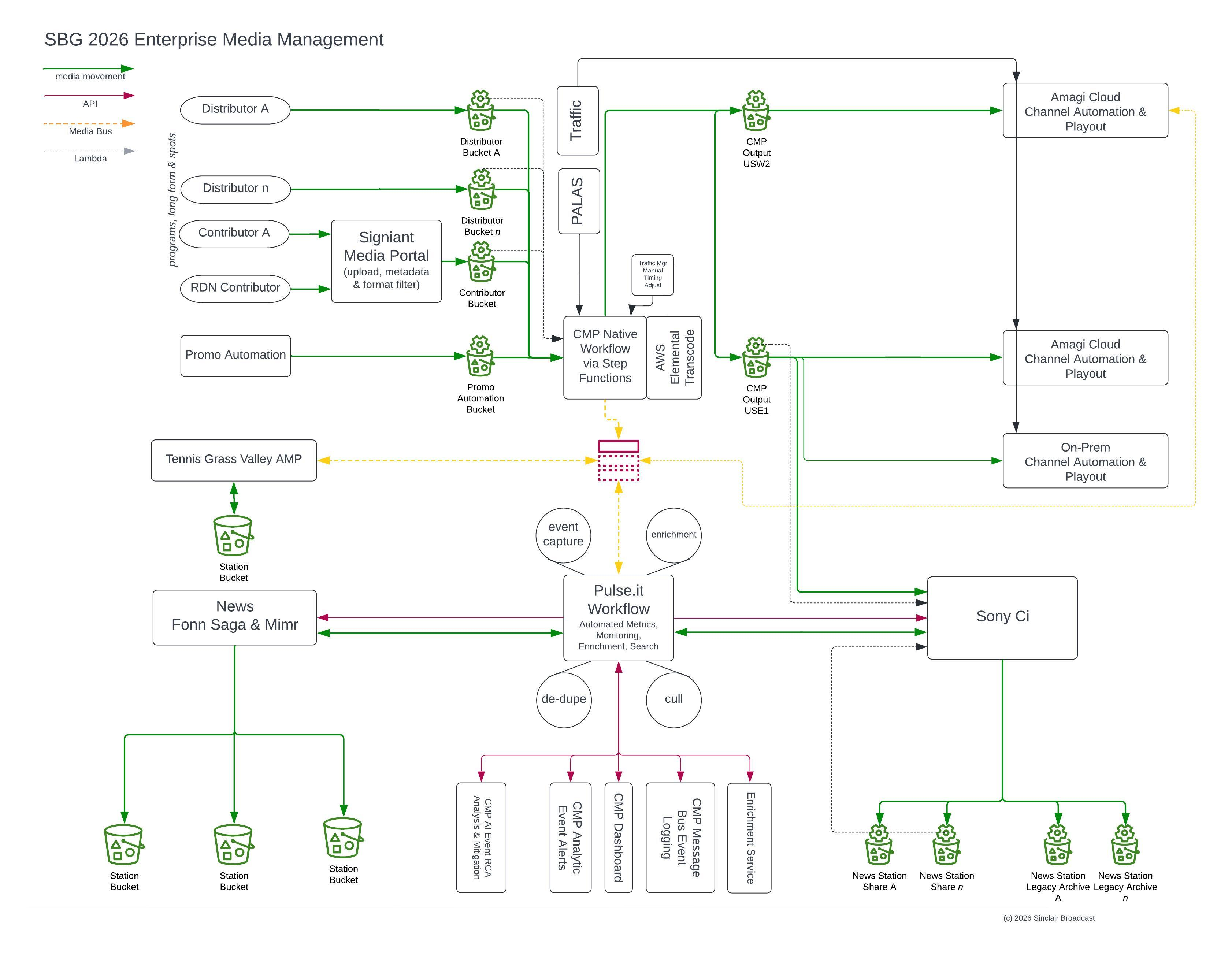
Figure 2. Sinclair's 2026 aggregate media-management architecture connects distributor, contributor, promotion and news sources to CMP workflow, regional output repositories, cloud playout, Sony Ci and shared workflow services through common media, API and Media Bus paths.
Metadata independence from individual components
The governing media-management principle is metadata independence. Each asset is paired with an authoritative metadata sidecar file containing its durable material metadata. A vendor may import that information into an operational database, but material changes return to the sidecar. This allows the current service—or its replacement—to rebuild the database without trapping the asset's durable
description inside a proprietary platform. For syndicated programs, the sidecar can identify program
boundaries, segments and commercial breaks, allowing automation to use the correct portions without unnecessary physical edits. For news content, the sidecar contains structured and unstructured metadata, including time-aligned metadata that frequently results from artificial-
intelligence enrichment.
The Media Bus provides the common operational conversation. Services publish normalized requests, events and status messages through Amazon SNS instead of requiring a separate point-to-point connection for every component relationship. Snowflake analytics services consume those messages to determine whether an asset was received, processed, moved or delivered; measure
how long the process took; and support dashboards and longer-term analysis of performance, cost and system changes. Together, accessible media, durable metadata and shared, measurable events substantially reduce vendor lock-in because a component can be added or replaced without
rebuilding the supply chain.
CMP connects technical workflow to the departments that commission, schedule, produce and use
content. Traffic and program scheduling, promo production, internal commercial production, enterprise security and common support services consume CMP services.
Measured results and the next fabric extension
As of August 7, 2026, CMP processes approximately 14,000 unique files each week; the approved end-state range is 15,000–20,000. Elastic processing routinely supports 100 or more simultaneous transcodes. A 30-second commercial that could take two hours or more during a legacy Thursday peak now generally completes in less than five minutes. That result represents a reduction of more than 95% in peak processing time and is verifiable through Snowflake.
CMP has enabled retirement of on-prem transcode systems for spot and syndication media ingestion across all 65 sites. In addition to producing media renditions for Amagi cloud playout, CMP also produces renditions for the remaining legacy on prem automation and playback systems while we wait for them to be replaced. The ability to dynamically choose what renditions we choose to create, and for how long, has allowed us to retire one distributed technology layer without forcing every downstream migration to finish at the same time.
CMP also became a proving ground for governed internal development. On June 1, 2025, we determined that CMP's original transcode and media-workflow component would not support the approved end-state scale. We chose to replace it with an internally developed workflow rather than purchase another proprietary workflow and transcode engine. Using OpenAI Codex, we translated the required processing logic into Sinclair-managed serverless code in AWS Step Functions. On July 1, 2026, that code entered production, orchestrating media processing and calling AWS Elemental MediaConvert for transcoding. The workflow was developed under our security, code-review and supportability controls. The Fabric's flexible service boundaries enabled the move from a vendor's proprietary system to internally developed, open workflows without modifying adjacent dependent services or disrupting service continuity. The new workflow processes media faster and uses compute more efficiently; replacing the prior component also eliminated more than $1 million in software licensing and support expense. This work established a repeatable pattern for building focused cloud-native media services and incorporating them into the Fabric.
Cloud Playout
A common, location-independent service for channel playout
Sinclair integrated Amagi cloud playout with CMP and the fabric core through an AWS Lambda-enabled Sinclair Media Bus workflow in June 2023, and the first station went on air on October 17, 2023. The service draws on prepared commercials, syndicated programs and promos; durable metadata; standardized events; cloud storage and compute; Sinclair's corporate network; and common enterprise security, auditing and support services. We replaced varied local station automation platforms, email-based instructions and operating knowledge tied to individual markets with a centralized cloud playout service that handles every destination consistently.
Before the transformation, daily dub lists arrived by email. Operators located the required spots, quality-checked them and moved them into local players. Station traffic schedules followed another manual path: operators downloaded the log from Outlook, loaded it on a local server, checked it and published it. Today, traffic instructions drive automated search, tagging and movement through CMP into Amagi. Schedules transfer from the OSI traffic system directly into cloud playout for processing and publication. The operator confirms that the playlist is ready instead of rebuilding the handoff at each station. As-run logs move automatically into centralized reconciliation.
This centralized automation improves quality as well as speed. Under the old station-based model, each destination performed substantially the same quality-control review on its copy of every syndicated program or spot. CMP now performs automated quality control centrally, with review by one person when required. When the workflow detects a missing caption, incorrect version or other defect, the issue is addressed upstream before later stations use the asset. The correction follows the shared media rather than remaining local knowledge at the first station that encountered the problem.
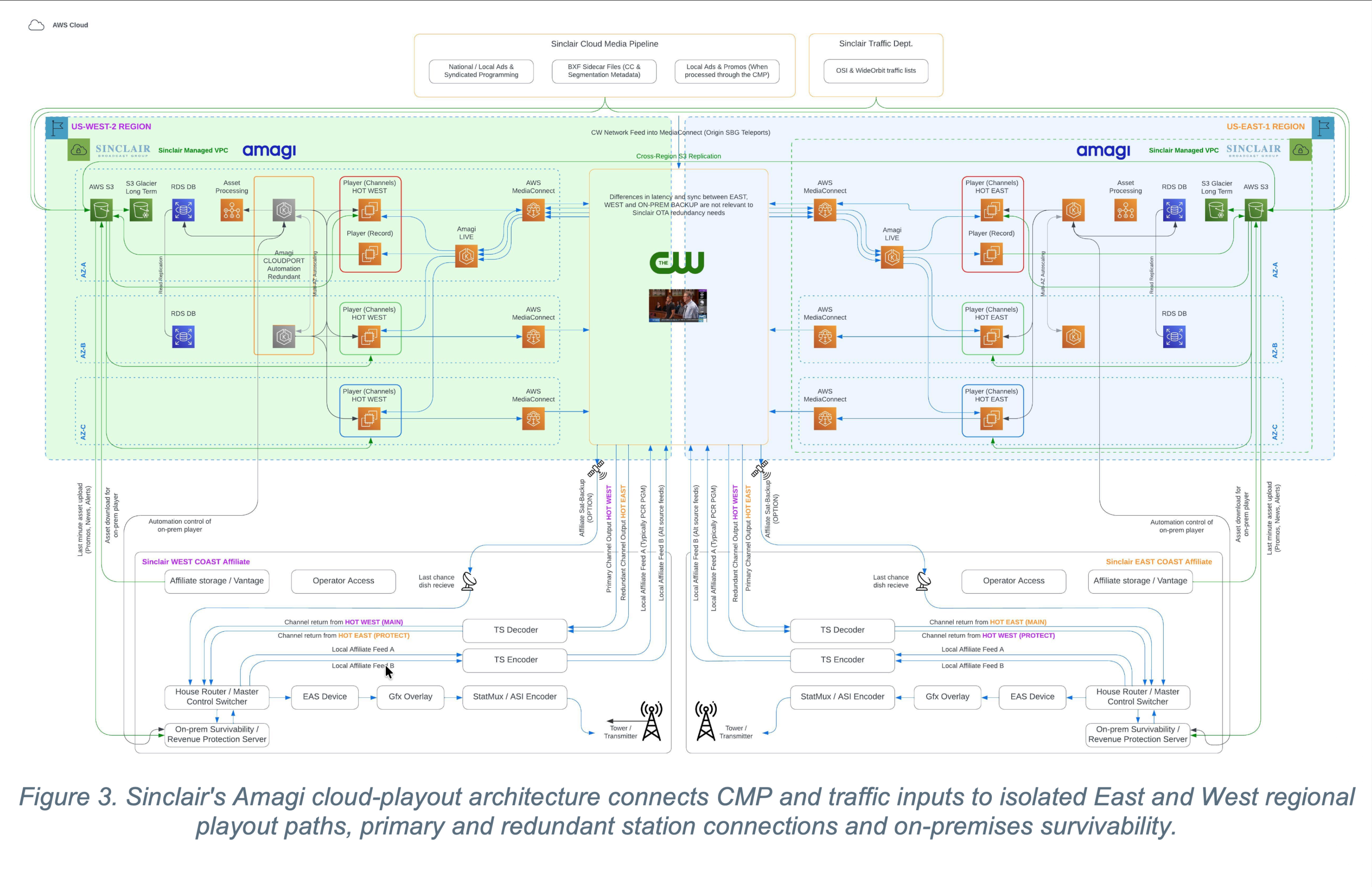
The resulting service has several coordinated layers. CMP and OSI supply media and schedules to Amagi. Sinclair maintains isolated East and West playout paths in Amazon Web Services (AWS). Geographically dispersed Media Operations Centers (MOCs) control the channels, while TAG monitoring gives operators visibility across the cloud paths and station disaster-recovery output. Stations receive the cloud signals through a standardized air chain with continuously synchronized local disaster-recovery playout. The cloud output feeds the linear transmitter and approved digital destinations simultaneously. Figure 3 shows part of the regional cloud architecture and its primary, redundant and survivability paths to Sinclair stations.
The news and playout workstreams also developed synergistic capabilities. Their integration replaced approximately 60 on-premises Chyron PRIME graphics systems with a centralized Flowics cloud graphics service supporting station elements such as tickers and J-bars. This demonstrates that playout and Content Center Transformation—News (CCT News) were designed to share live and graphics services through the fabric instead of maintaining separate station integrations.
The most difficult part of implementation was adapting the human workflow. Operators accustomed to frame-scale response in a local baseband plant had to learn a distributed Internet Protocol (IP) and cloud chain with seconds of control latency. We revised training and operating procedures as deployments progressed. Engineering modeled bandwidth at the station, cloud and inter-region levels and prepared procedures for path, AWS Availability Zone, AWS Region and AWS Direct Connect failures. The rollout therefore proceeded on two tracks: one maintained the deployment schedule, while the other continued to improve monitoring, formats, operating practices and the user workflow.
As of August 7, 2026, 146 channels are operating through Amagi, representing 79% of the approved 185-channel end state. The final station is scheduled to go on the air on November 20, 2026. The Abilene tornado recovery demonstrates the deployed architecture under real operating conditions. After the storm disabled the station building, power and network, the channel already operating in the cloud was routed through Sinclair's Hunt Valley satellite infrastructure to a receiver at the transmitter. We restored the feed within a few hours by bypassing the unavailable station plant rather than rebuilding local playout first.
Standardizing the station edge without surrendering local control
The physical transformation at the stations was substantial. Sinclair had inherited multiple automation and playout platforms across its station group, including an installed base composed predominantly of Sundance systems that had reached end of life and become difficult to support. We rejected another site-by-site replacement cycle and instead reduced the local footprint to a standardized receiving, monitoring and compliance architecture as we moved playout to the cloud. At migrated sites, station engineers now maintain the local air chain and its compliance functions without sustaining a separate automation and playout stack.
Standardization made the station edge another reusable part of the Fabric. The core design first deployed in Raleigh remained the program standard roughly three and a half years later. Air chains are consistent down to wire numbering. Engineering configures each station package from its channel, format and production-control-room requirements. Support teams use the same drawings, operating assumptions and replacement strategy at every deployed edge. Figure 4 documents the Tulsa ABC air chain as one representative portion of that on-premises architecture.
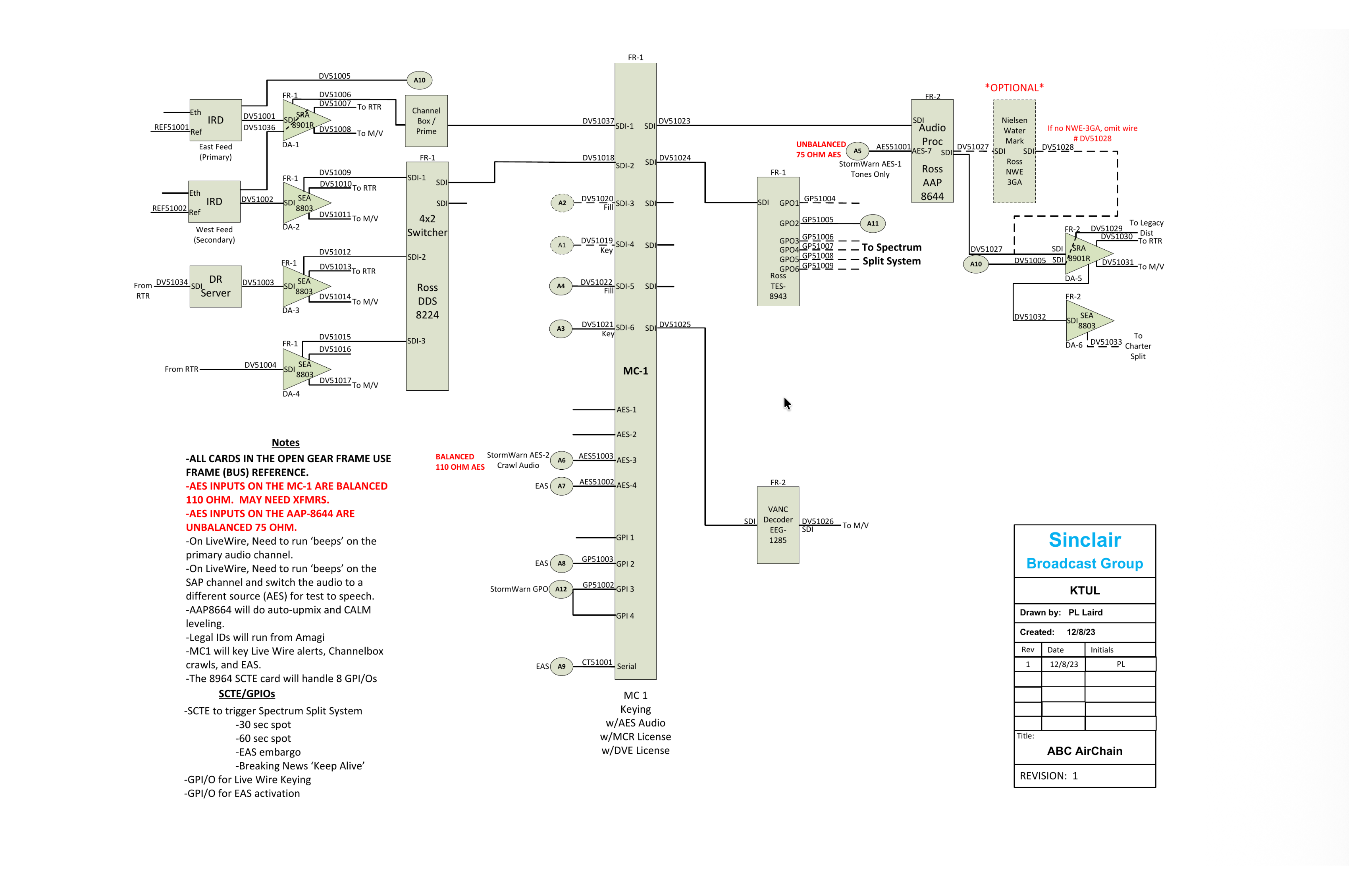
Figure 4. The Tulsa ABC air-chain design documents a representative portion of the on-premises station architecture, where primary and secondary cloud feeds, local disaster-recovery playout, switching, compliance processing and downstream distribution converge.
The standard design also preserves layered continuity. A path failure triggers automatic use of the alternate terrestrial connection. If both connections are lost, continuously synchronized local disaster-recovery playout carries stored programming, network sources and local news. For an extended terrestrial outage, Sinclair uses its Hunt Valley satellite path. Each station retains a direct route from its production control room to air for breaking news in the event of a complete network failure. The normal point of origination changed; the station's ability to serve its market did not.
Prentis Laird, VP, Station Engineering, explains the model directly to station leaders:
“You're not losing master control. You still have master control. It's just not in your building anymore.”
.png?width=3456&height=2234&name=Untitled%20-%2014%20August%202026%20at%2015.59.20%20(1).png)
Figure 5. Media Operations Centers (MOCs) are geographically distributed, but generally operate a collection of channels belonging to the same network affiliation, regardless of what market an individual channel might be associated with.
Network-aligned control as an internal service
Media Operations Centers (MOCs) are physical locations where multiple operators oversee and monitor cloud playout. Sinclair operates eight MOCs which are generally aligned by network affiliation. Each MOC team develops operating knowledge around a network's programming and repeats the same practices across its affiliates on one common platform. MOC location follows workforce and business conditions rather than transmitter geography. Authorized alternate and disaster-recovery locations monitor and control the channels when required.
That location independence creates an additional form of continuity. During a Fox Super Bowl broadcast, the Chattanooga MOC mirrored the Pittsburgh MOC's operations. Redundant station equipment and circuits were therefore backed by an alternate operating facility ready to assume channel control if Pittsburgh became unavailable. The architecture supported recovery across facilities without rebuilding the channels or moving the transmitters.
Tony Tarud, VP, Cloud Media Operations, describes the MOC organization as an internal service provider whose clients are Sinclair stations. That is the operational consequence of the common platform. The workstream contributed location independent channel control, network-aligned operating practices, shared monitoring, alternate-facility recovery and a standardized station service back into the Fabric. CCT News reuses cloud graphics, live production-control-room feeds and direct digital distribution as established services rather than creating another set of station-specific connections.
Content Center Transformation - News
From station-bound tools to a story-centered shared workflow
The legacy newsroom environment was designed primarily around linear production inside the station. Its metadata was limited, integrations were difficult to add and feature changes followed long product cycles. Field reporters had fewer ways to share scripts, media and developing information with newsroom colleagues in real time. Meanwhile, the audience was moving across linear, web, mobile and social platforms with different editorial and presentation requirements. Replacing an on-premises application without changing those relationships would have preserved the central constraint: the story and its media would still have moved through separate workflows for each destination.
Content Center Transformation—News (CCT News) was built on services established by the two preceding workstreams. It reuses Sinclair's network, cloud compute and storage, enterprise security, auditing and support services, together with the media, metadata, orchestration, events and telemetry contributed by the Cloud Media Pipeline (CMP). It also reuses Amagi cloud playout, production-control-room inputs, centralized Flowics graphics and direct cloud distribution. Reporter-Driven News (RDN), a CCT News capability, depends on those connections. RDN automates the submission and linear airing of completed reporter packages. A completed package must move predictably from the field through CMP and into the newscast workflow while the story is also prepared for other screens. Building news as a silo would have recreated the handoffs that the fabric was designed to remove. As Ernie Ensign, Sinclair VP, News Technology, explained,
“If we didn’t have these interconnected pieces within the operating fabric, it would be very difficult to build the APIs and integrations that make these transformational, story-centric workflows possible.”
We built the connected newsroom layer around two Fonn Group services with distinct roles. Saga provides the cloud-native, story-centered newsroom and rundown environment for planning, writing, collaboration and publishing. Mimir provides cloud production-asset management and video collaboration. Both Saga and Mimir are cloud-native, serverless production tools that supply core technical and editorial functions for news. Sinclair designed the workflow and integration that govern how these products interact with field contributions and archive material as they flow through CMP processing, Amagi playout, graphics and publishing endpoints. Approved content moves through the connected cloud-native workflows to online and social publishing tools rather than being copied manually from an on-premises linear production system.
The practical change was not simply that journalists received a newer newsroom system. The operating model shifted from a station-centered, application-centered workflow to a story-centered workflow in which the story record, media, scripts, metadata, rundowns and downstream publishing paths are connected earlier in the process. That distinction is central to the transformation. In the legacy environment, each platform often required its own handoff, recreation of context or manual movement of assets. In the CCT News model, the story becomes the organizing object around which field contribution, editorial collaboration, media management, production, archive and publishing can operate.
From the field to air and every screen
The camera-to-cloud path contains two related flows. In the first, raw material, scripts and story details reach the newsroom while reporting continues in the field. Through the mobile workflow, a journalist writes or dictates a script, contributes media and works against the same story record visible to newsroom producers and editors. Colleagues respond as new details, scripts and video arrive. The reporter no longer operates as a disconnected endpoint that must reconstruct the story context after returning to the station.
This changes the field workflow in a way that is directly visible to local newsrooms. A reporter can continue gathering information, writing copy and contributing media while the newsroom sees the same evolving story context. Producers and editors no longer wait for the reporter to return to the station or for media to move through a separate ingest path before production decisions begin. The effect is a shorter distance between reporting and use: the story can be shaped, reviewed, prepared for air and positioned for digital distribution while the reporting process is still active.
The second flow carries the finished Reporter-Driven News package. The journalist completes the package in the field, including the required graphics and live elements, and submits a self-contained version. Signiant Media Shuttle carries the package and routing information into CMP. CMP prepares and normalizes the media, then makes it available to Amagi for the newscast playlist within the Fonn-supported editorial workflow. Approved versions also move to web and social publication.
Reporter-Driven News is one of the clearest operational expressions of the Fabric-enabled model. It allows a journalist to remain in the field, complete a package and deliver it into an integrated newscast and automated multiplatform delivery workflow using the full span of the Fabric: core services, CMP, Amagi and CCT News. RDN is currently deployed in 11 markets and produces approximately 300 stories each day, or 2,100 per week.
Figure 5 shows how station production, field operations, performance hubs, cloud-hosted newsroom services and external destinations participate in the connected architecture.
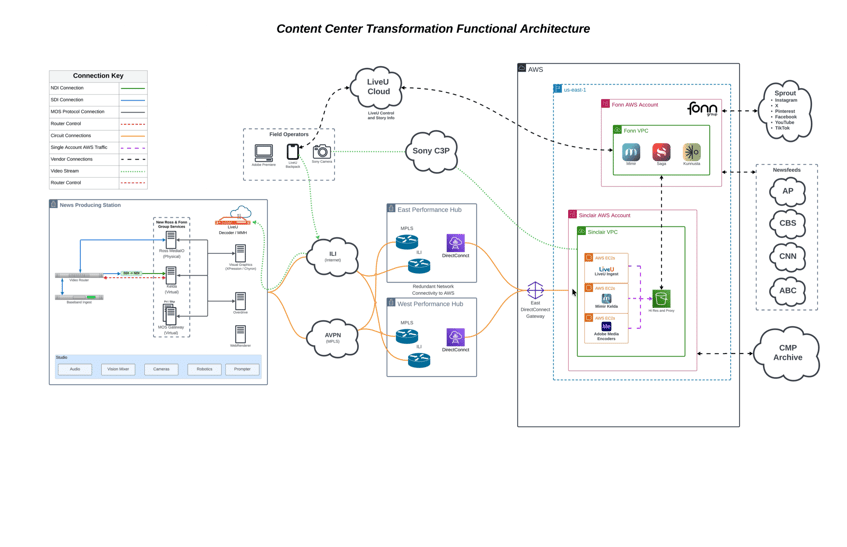
Figure 6. Content Center Transformation—News connects station production and field operations through redundant performance hubs to Sinclair- and Fonn-operated cloud services, external news and social sources, and the CMP archive.
Governed automation buys back editorial time
The connected environment also makes existing media more useful. Moments Lab and other artificial intelligence (AI) services can enrich work in progress and archive content with additional descriptive information so journalists can discover relevant footage by content and context rather than relying only on a file-level description. Amagi-assisted workflows identify stories and segments, create clips, apply graphics and reframe 16:9 horizontal material as 9:16 vertical video or other destination-specific formats. The workflow places the resulting packages where editorial users can review, adjust and approve them for digital and social use. The system prepares the version; the journalist or editor decides whether to publish it as is or make incremental changes first.
That same division of responsibility governs other AI functions. Transcription supports text-based editing and time-aligned discovery. Saga's Ask AI presents 13 human-crafted prompts shaped by editorial policy, tone and intended audience. They assist with teases, rough voice-over drafts, web scripts, short promotions, questions and story analysis. When triggered, editorial-intelligence workflows assemble known story details and source material into draft options and analysis.
Automated story-boundary detection segments a newscast and prepares versions, but human editorial approval remains the gate before publication. Natural-language requests for fully assembled, platform-specific packages remain a future direction and are not presented here as a current production capability.
Within the news operation, the goal is described as “buying back time.” A few minutes recovered from logging, searching, switching applications or recreating a platform version may appear modest in isolation. Together, those gains return time to reporting, verification, interviews and editorial judgment across a journalist's day. Transcription-based editing, shared story context and prepared versions reduce workflow friction.
A repeatable model for local news
Figure 7 presents the CCT News rollout beginning October 1, 2025. Once the technical, operational and training patterns were established, standardized technical deployments were followed by adoption of new editorial workflows and products. For smaller markets in particular, the operational value is practical: the cloud workflow makes local news production more efficient while preserving the reporting, editorial review and market knowledge on which the service depends.
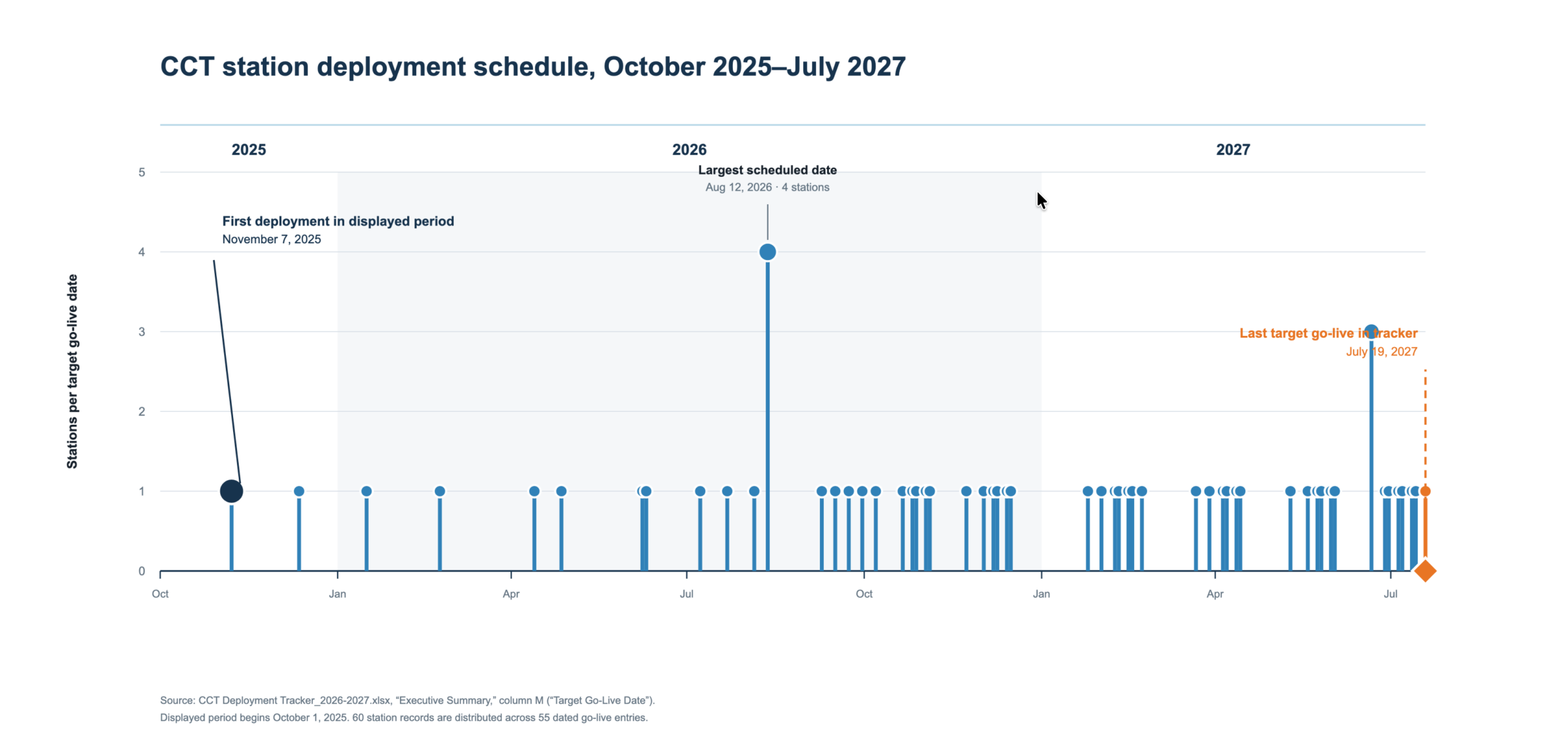
Figure 7. The CCT tracker lists 60 station records across 55 target go-live dates in the displayed period, ending July 19, 2027. One earlier dated record brings the full tracker total to 61.
The hardest implementation issue was not connecting the services; it was changing daily newsroom practice. CCT News is a different operating philosophy, not one new tool. Users must learn to edit through transcripts, collaborate through a shared story, work from the field, review automated versions and publish for several destinations instead of reproducing the old linear process in new software. Training and adoption therefore remain part of the engineering work.
CCT News consumed capabilities from the fabric and returned a reusable news-production layer to it. Field contribution, mobile collaboration, story-centered editorial context, archive discovery and enrichment, governed AI assistance, clipping, aspect-ratio versioning, human-approved publishing and the Reporter-Driven News integration pattern are now available to other and future services.
CMP gave news a production media supply chain, and Amagi gave it shared playout, graphics and distribution. News extended that foundation to the point of reporting and to every platform on which Sinclair serves an audience. CCT News required a formal change-management model because the transformation affected daily newsroom behavior, not just the underlying technology. Sinclair organized deployments around leadership alignment, super-user preparation, web-based training, mock rehearsals, go-live support and post-launch hyper-care. Each market had to learn new patterns for story collaboration, transcript-based editing, field contribution, automated versioning and multiplatform publishing. This adoption model allowed technical deployment and workflow change to move together, reducing the risk that users would simply recreate legacy linear processes inside new cloud-based tools.
Vibe-coded Champion Projects
As the fabric expanded to include the three major workstreams, it also changed who can create enterprise capabilities. Sinclair engineering staff now use Vibe Coding—AI-assisted development guided by people who understand the operational or creative problem—to build focused products That conventional development costs might make impractical. Each Sinclair project reuses standardized fabric services, integration patterns and controls, then contributes a supported capability back to the Fabric. Departmental champions retain product ownership.
Figure 8 shows four projects entering production from April through August 2026 and the Fabric-connected operational agent scheduled for September 2026.
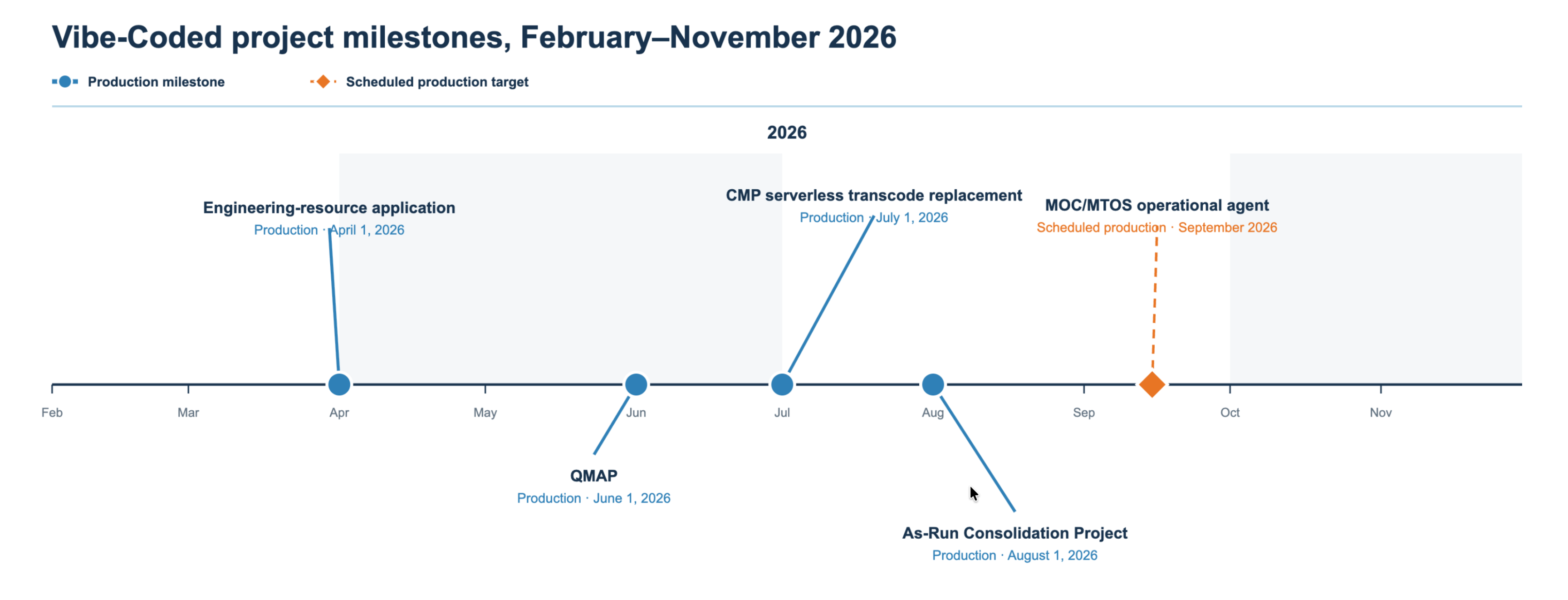
Figure 8. Four vibe-coded projects entered production from April through August 2026; a Fabric-connected operational agent is scheduled for production in September 2026.
The CMP syndicator-ingest replacement became Sinclair's first internally developed project to use a fully serverless architecture when it entered production on July 1, 2026. OpenAI Codex and other tools helped translate its workflow into Sinclair-managed code, with AWS Step Functions orchestrating AWS Elemental MediaConvert. The replacement eliminated more than $1 million in legacy licensing fees and contributed a Sinclair-managed media-processing service to the Fabric. Figure 9 shows the production workflow.
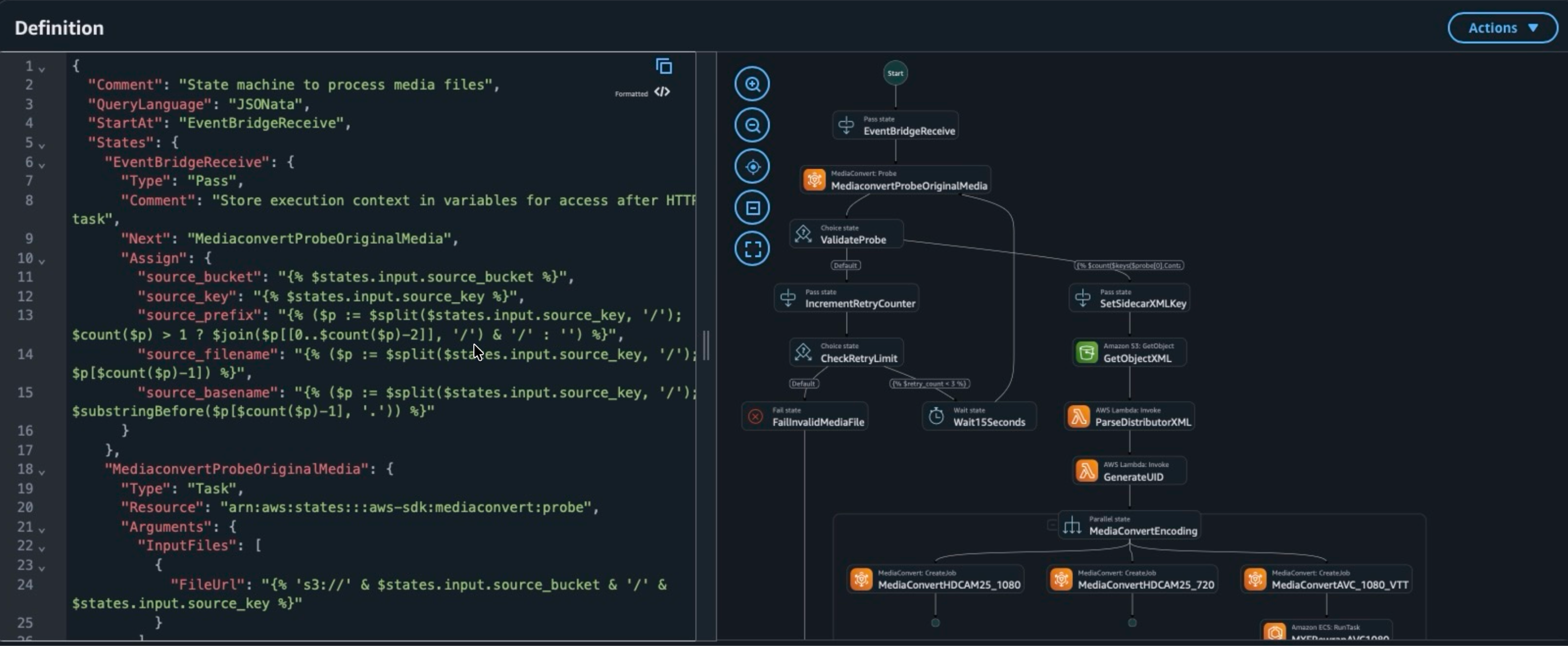
Figure 9. The CMP syndicator-ingest replacement uses AWS Step Functions to orchestrate media validation, metadata
handling and parallel AWS Elemental MediaConvert processing in a serverless workflow.
Three additional vibe-coded projects entered production between April and August 2026. One is a bespoke application that tracks engineering resources, transmitter data, tower information and related operational records. Marketing staff developed QMAP as a scalable cloud service that creates localized versions of syndicated promotions. The third, the As-Run Consolidation Project, entered production on August 1, 2026.
A fifth vibe-coded project is scheduled to enter production in September 2026. This Fabric-connected AI agent for MOC and MTOS operators will query system status, support low-level root-cause analysis after an incident, consume established fabric capabilities and contribute a new operational service.
Vibe Coding does not bypass production discipline. Code proceeds through security, supportability and optimization reviews before entering controlled repositories. Every product must meet the controls applied to Fabric-connected systems.
Sinclair Media Operations Fabric: Continuous Transformation
Sinclair began with a strategic judgment: technology could no longer constrain its response to opportunity or audience change. Broadcast operations needed the adaptability of a digital-media business, including rapid testing, release, prototyping, and reconfiguration. Beginning with the limited-production Cloud Media Pipeline (CMP) prototype on October 20, 2021, Sinclair built a cloud media nucleus, integrated playout, brought that nucleus to full production, replaced on-premises channel playout with Amagi cloud services, began Content Center Transformation—News (CCT News) deployments and launched vibe-coded services—all within the Sinclair Media Operations Fabric architecture. The rollout cadence of fabric components through 2027 reflects sustained planning, iterative development and disciplined execution.
The evidence supports the award case even before deployment is complete in 2027. CMP currently processes approximately 14,000 unique files each week, and a 30-second commercial that could require two hours or more during a legacy Thursday peak now generally completes in less than five minutes. As of August 7, 2026, Amagi operates 146 of 185 approved channels, and CCT News supports approximately 300 stories each day across 11 markets. Four vibe-coded projects entered production between April and August 2026. The fabric already supports the media supply chain, playout, journalism and internally developed services with material impact on the business.
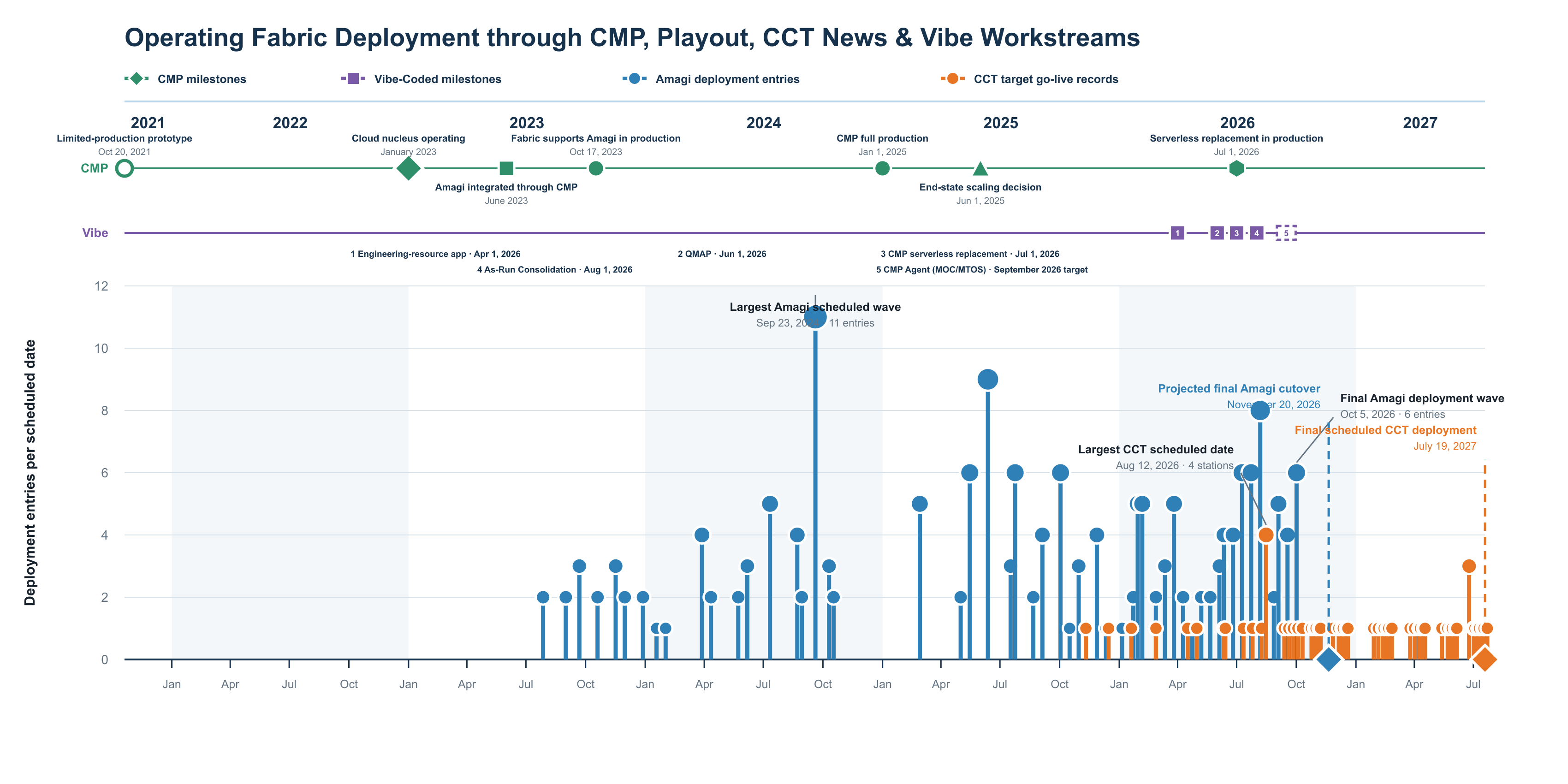
Figure 10. Sinclair's Media Operations Fabric advanced from the 2021 CMP prototype through integrated playout, CCT
News and vibe-coded production milestones, with deployment continuing into 2027.
The architecture creates flexibility in both technology selection and risk decisions. Durable metadata normalized events and stable application programming interface (API) boundaries reduce dependence on any component. In July 2026, Sinclair replaced CMP's original workflow component with Sinclair-managed serverless orchestration without changing adjacent services or disrupting continuity. The replacement eliminated more than $1 million in licensing and support expense, providing concrete evidence of reduced vendor lock-in.
That flexibility also enables a more deliberate approach to risk. Sinclair accepts additional operational risk only through intentional decisions measured against business value. Sinclair remains accountable as a trusted broadcast distribution source and continues to protect disaster recovery and resilience. It does not compromise functions for which the consequences of failure—or the value at risk—are too high. The adaptable ecosystem permits precise infrastructure, networking and control choices, with tolerances set in direct consultation with the business. Sinclair addressed the major requirements, learned in production and improved incrementally instead of waiting for every answer. When high-value programming required added protection, the teams adapted. Current APIs and Model Context Protocol (MCP) integrations already extend that governed flexibility, while planned vendor MCP connections establish the direction for further agentic control.
Delivering these capabilities in production also changed technology's relationship with the business while preserving local programming, emergency control and resilience. Mike Kralec, EVP and Chief Technology Officer, described the result:
“The business trusts our technologists to continue to deliver new transformations in the future.” That trust was earned through delivery; sustaining it depends on performance, governance, supportability and business partnership."
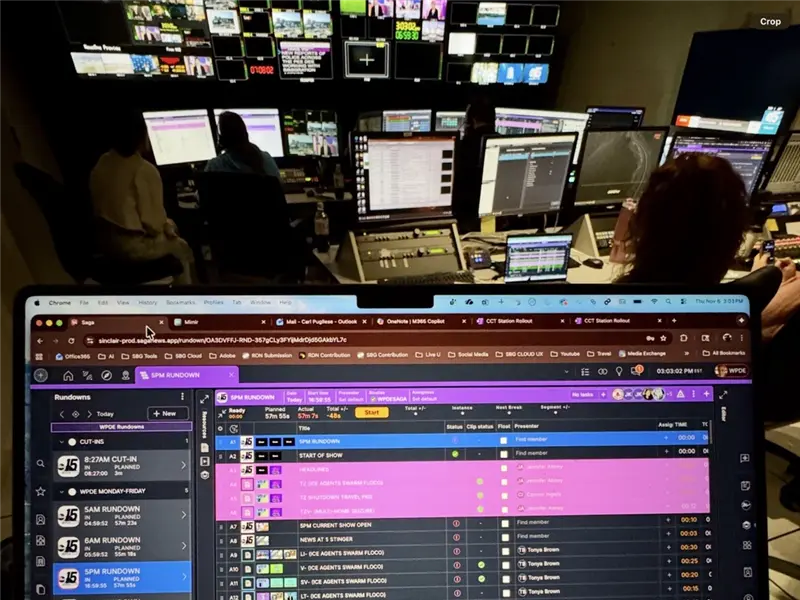
Sinclair photo of operators working with CCT – News tools from Fonn Group and others. CCT- News is a part of the Media Operations Fabric. It both contributes and consumes fabric services.